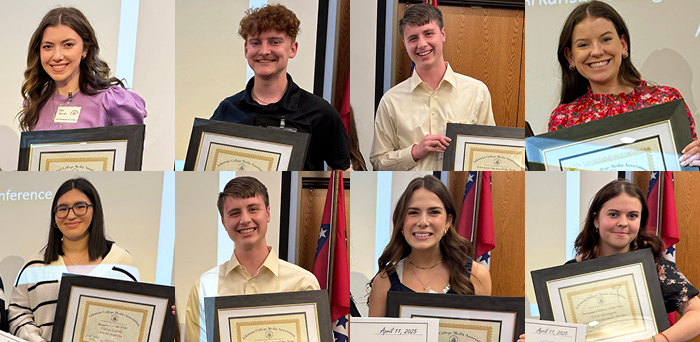
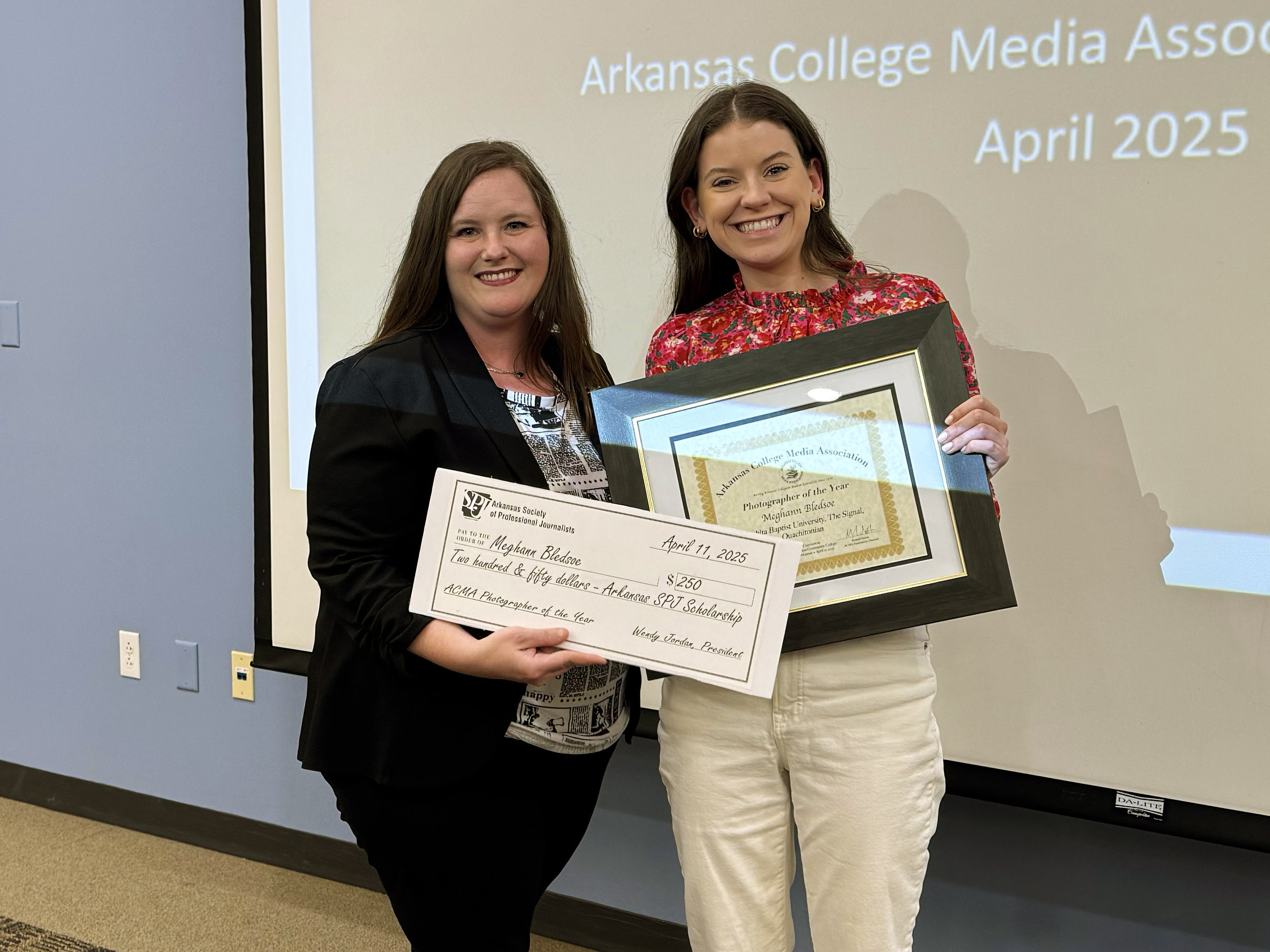
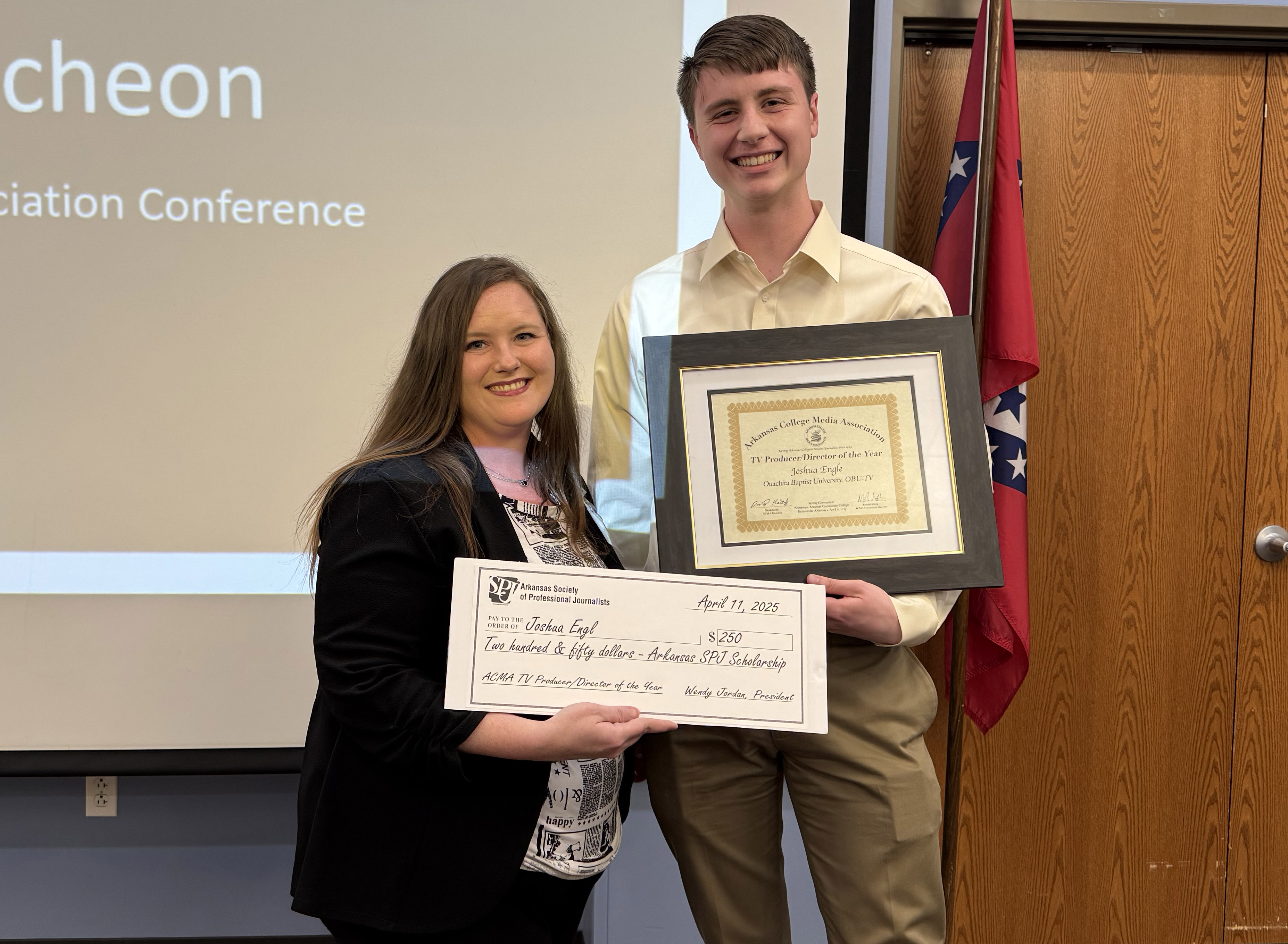
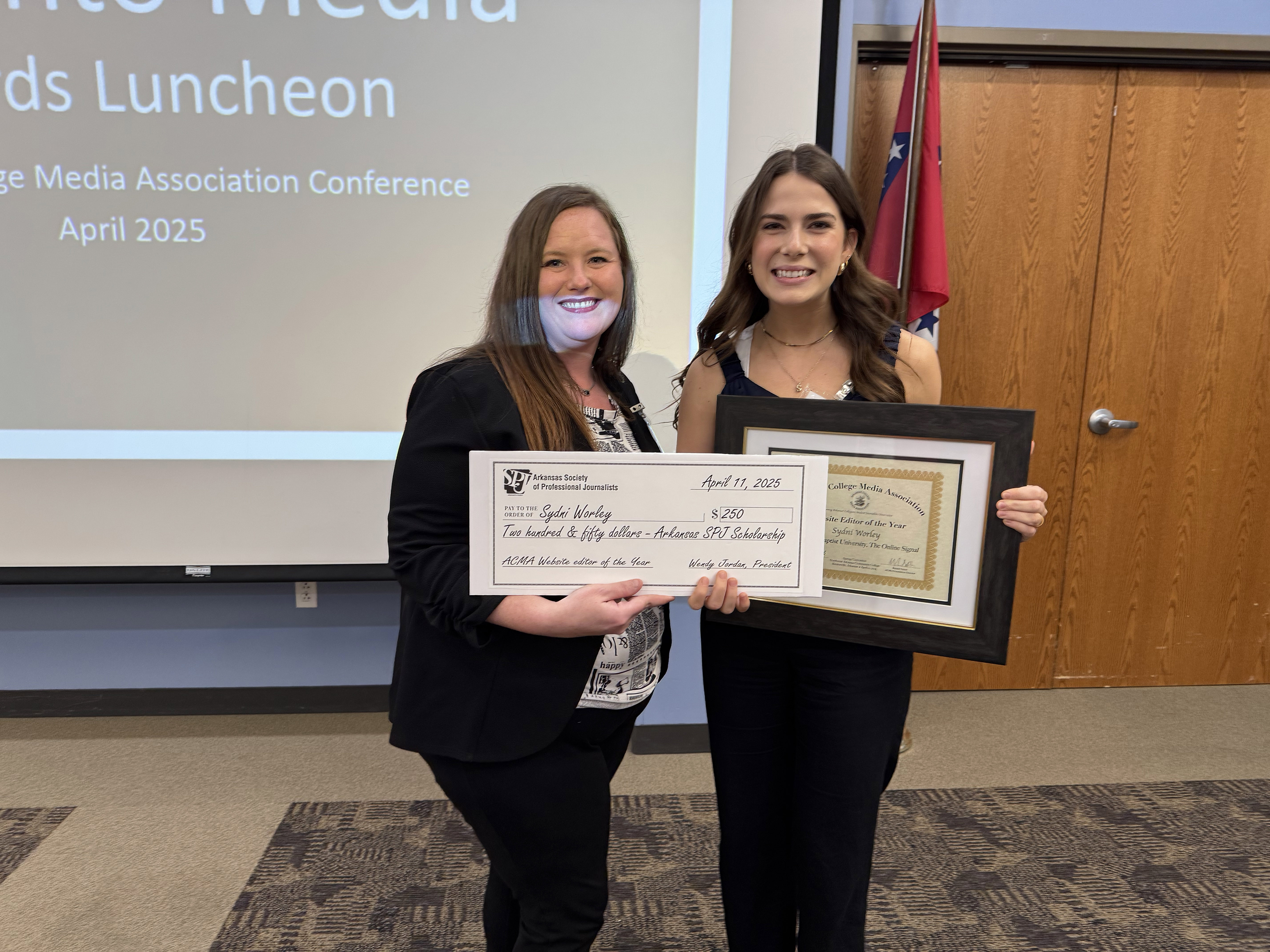
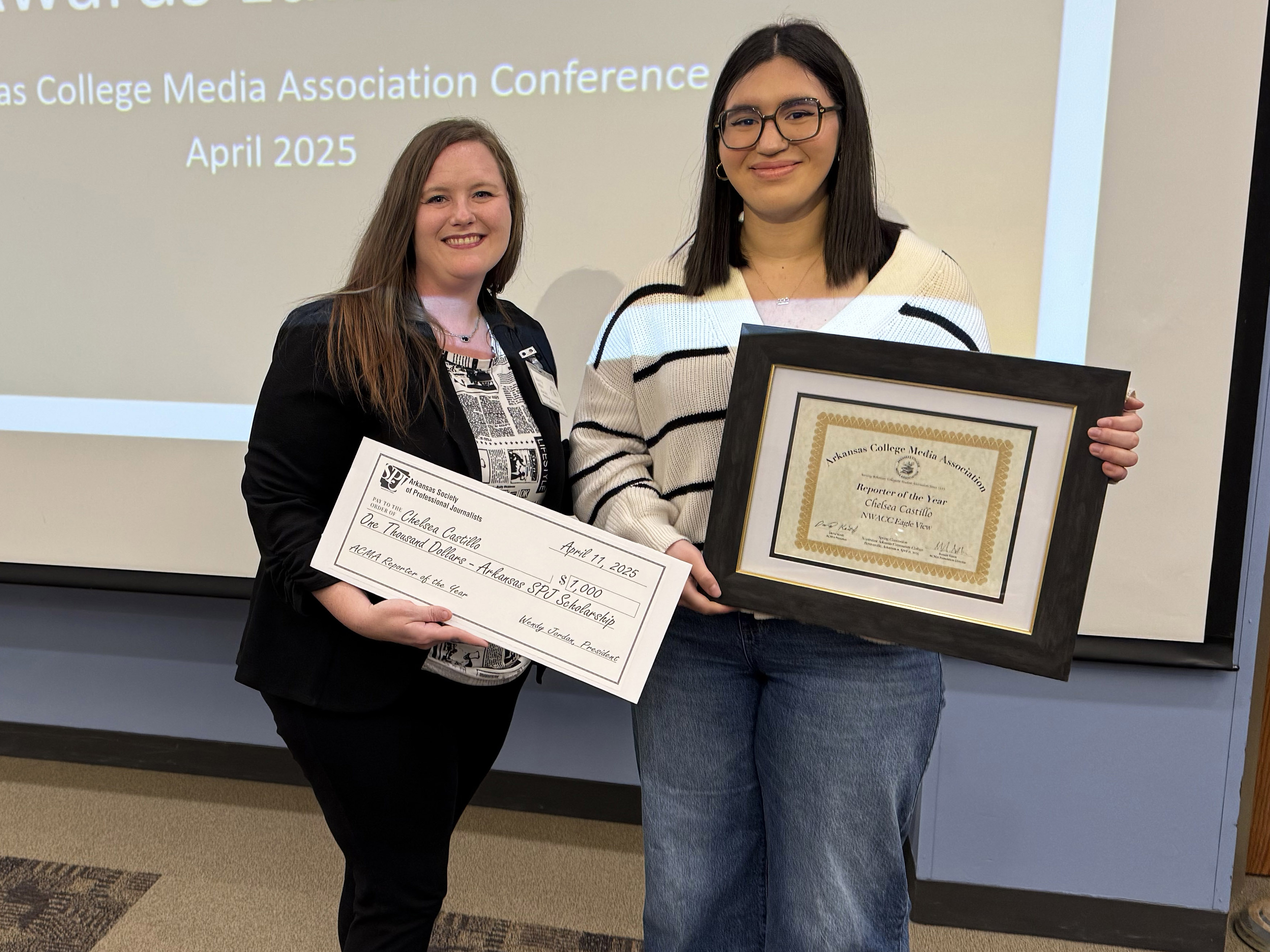
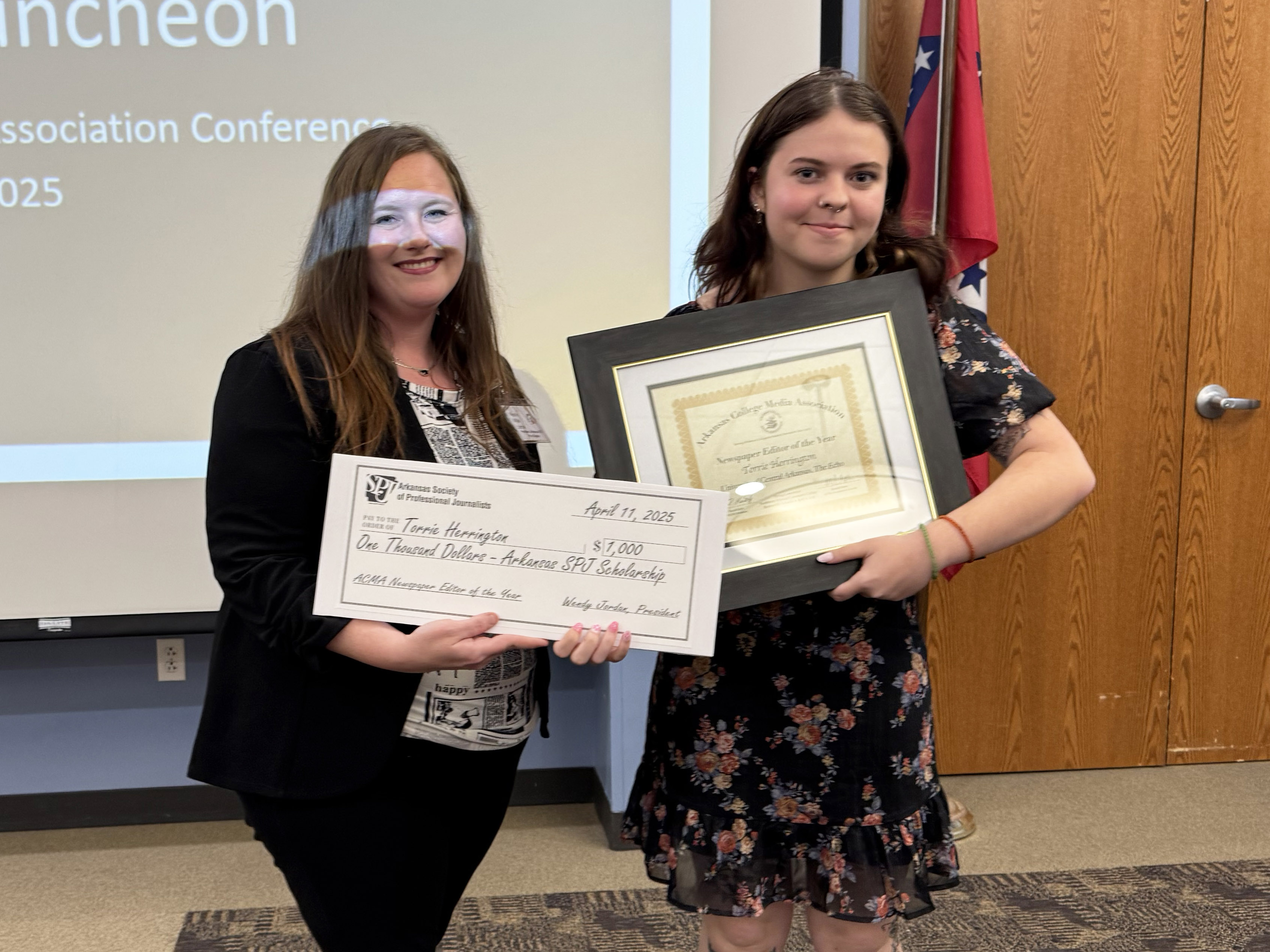
The Arkansas Pro Chapter of the Society of Professional Journalists awarded $3,500 in scholarships to eight students at the Arkansas College Media Association conference, which was hosted on April 11 at Northwest Arkansas Community College in Bentonville.
Scholarship checks were presented to the ACMA General Excellence award winners or a fellow student accepting on their behalf.
Newspaper Editor of the Year Torrie Herrington – The Echo University of Central Arkansas
Reporter of the Year Chelsea Castillo – Eagle View NorthWest Arkansas Community College
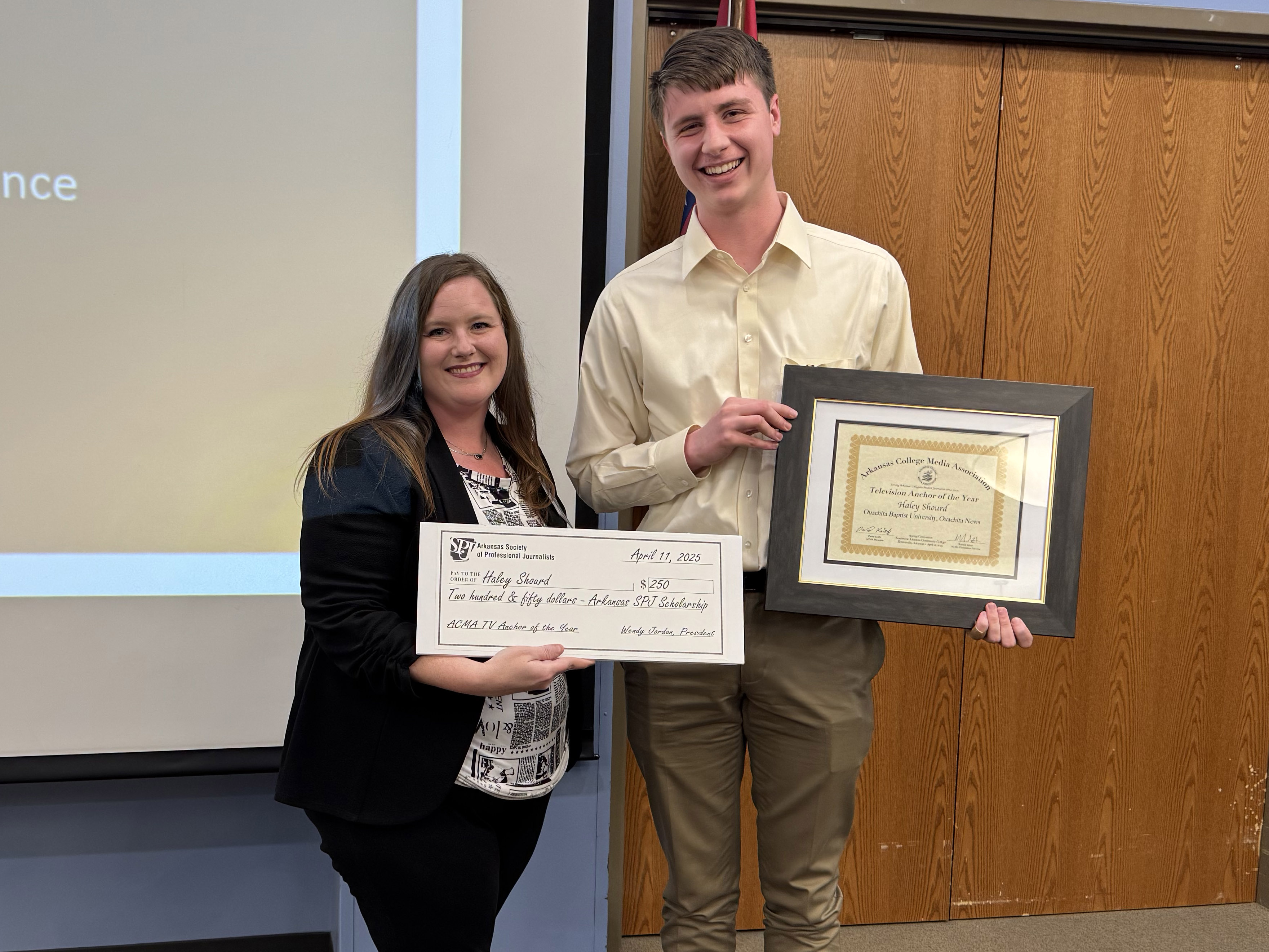
TV Anchor of the Year Haley Shourd, – Ouachita News, OBUTV Ouachita Baptist University
Photographer of the Year Meghann Bledsoe Ouachita Baptist University
TV Producer/Director of the Year Joshua Engle, OBUTV Ouachita Baptist University
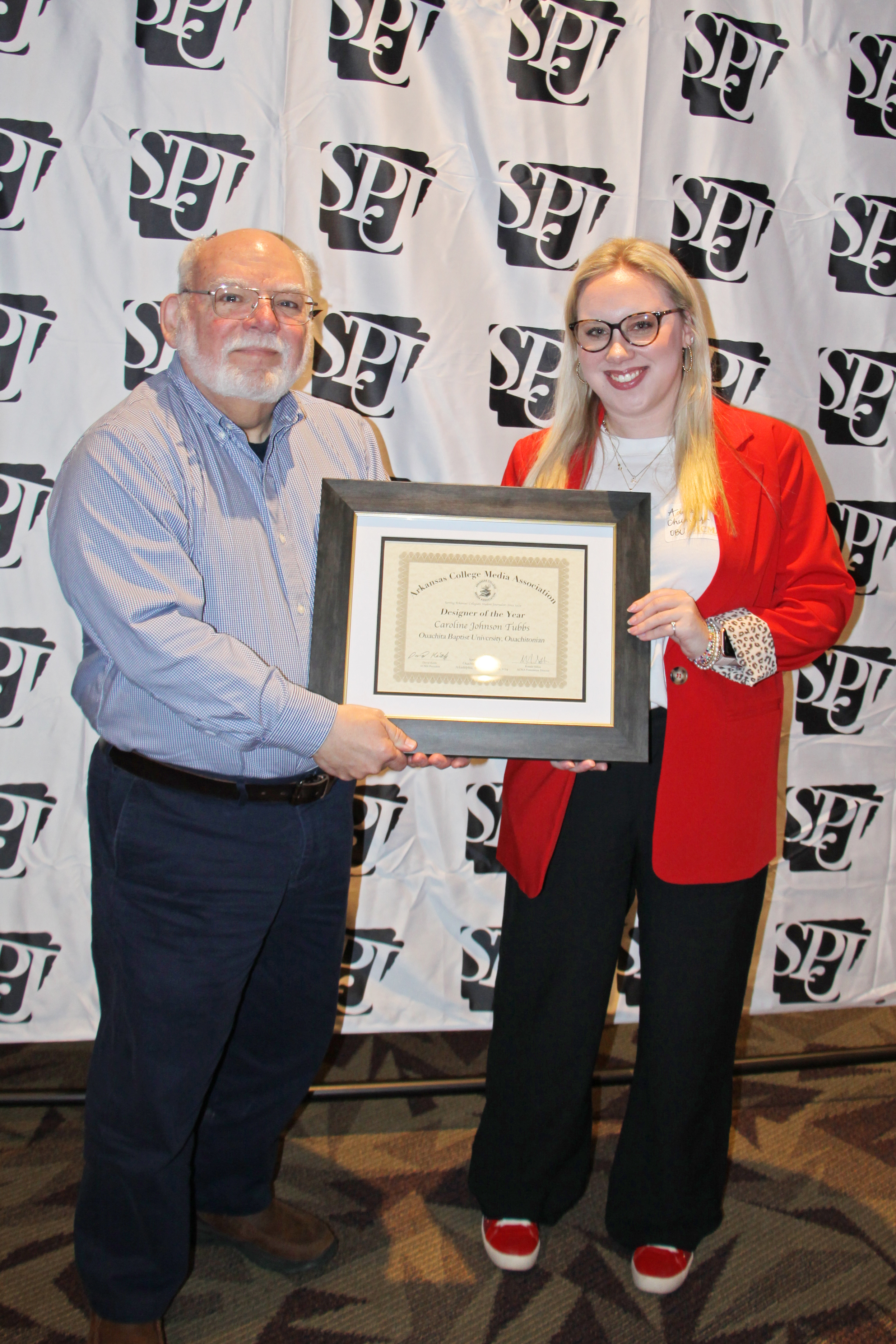
Designer of the Year Addie Chumley, Ouachitonian Ouachita Baptist University
Website Editor of the Year Sydni Worley, The Signal Ouachita Baptist University
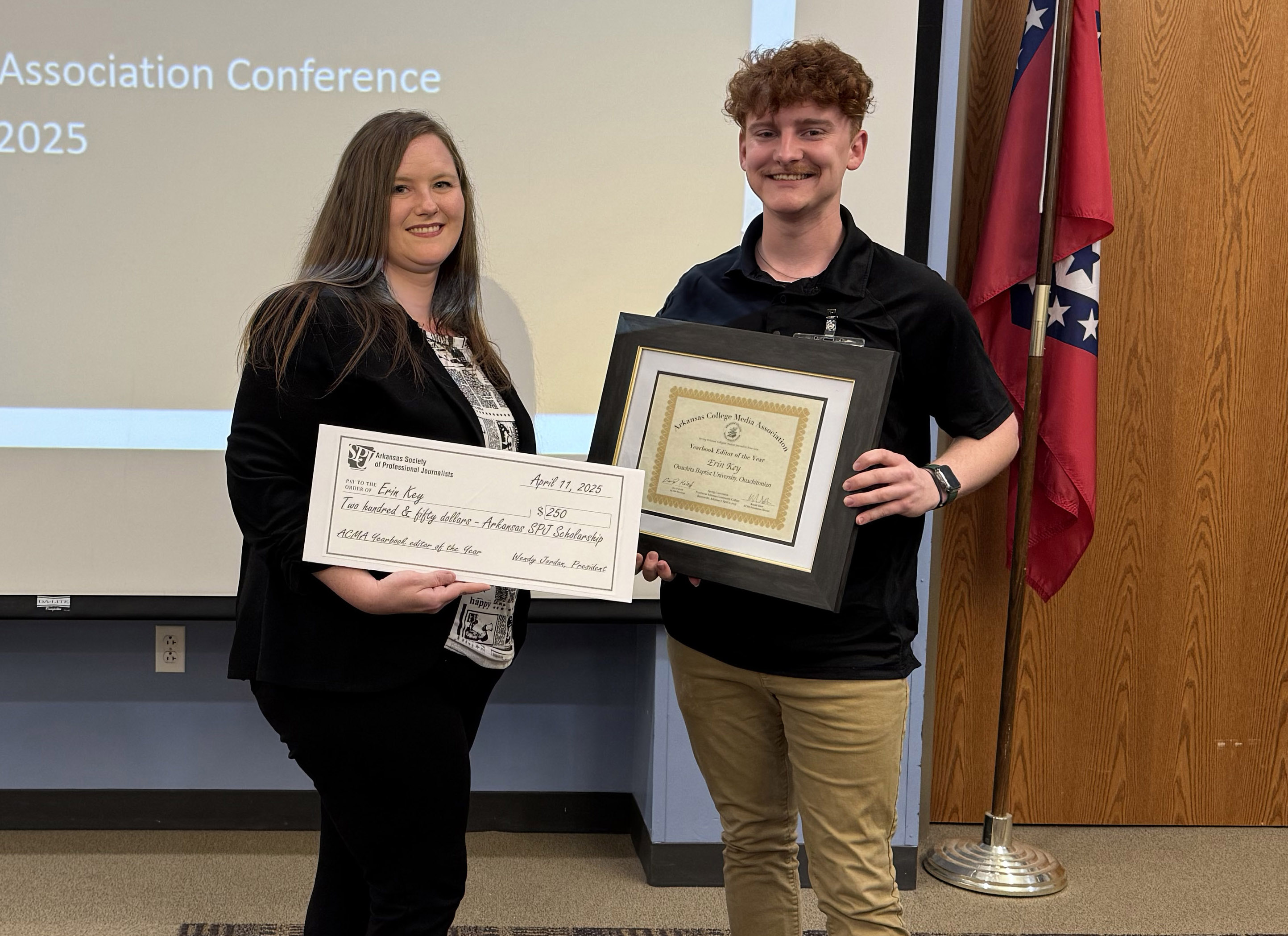
Yearbook Editor of the Year Erin Key, Ouachitonian Ouachita Baptist University
Searching for the truth is expensive. It takes time, resources and money, things a lot of newsrooms don’t have much of. But where there’s passion, there’s perseverance.
That’s why Arkansas SPJ and the A-Mark Foundation want to recognize investigative reporting and help to fund the continued effort. The A-Mark Prize will provide $15,000 each year for reporters and their newsrooms.
First place: $5,000 for the writer(s), plus $2,500 for the newsroom
Second place: $3,000 for the writer(s), $1,500 for the newsroom
Third place: $2,000 for the writer(s), $1,000 for the newsroom
Arkansas SPJ is one of only a few chapters hosting these investigative awards this year, and we are proud to partner with the A-Mark Foundation to continue the investigative efforts of hard-working reporters.
“The A-Mark Foundation hopes that our grants will lead to increased recognition and support for investigative journalists across the United States,” said A-Mark senior VP Tracey DeFrancesco. “We noticed that most state-level journalism awards did not have a cash prize, and we hope that providing a monetary award to both reporters and their publishing outlets will enable more important articles to be written.”
What you need to know
The A-Mark Prize for Investigative Journalism in Arkansas is described as an award for remarkable investigative reporting in any medium. *This prize is only open to entries with an Arkansas connection. The entry must include investigative reporting by an individual or team in a single report or a series – up to five items including coverage and other supporting elements. Stories should expose a wrong or promote understanding of a problem, issue or subject in the public interest.
The entry must have an Arkansas connection meaning one or more of the following applies: (1) The winning reporter is based in Arkansas; (2) The newspaper or media outlet is based in Arkansas; or (3) The work covers Arkansas. The entry must include investigative reporting by an individual or team in a single report or a series – up to five items including coverage and other supporting elements. Stories should expose a wrong or promote understanding of a problem, issue or subject in the public interest. A supporting statement (400 words max) is required.
The winners will be recognized, and the prizes will be distributed at the Arkansas Diamond Awards ceremony during Summer 2025. All entrants should plan to attend the ceremony in Little Rock in July if they are named a finalist.
If you have questions, email us anytime. The 2025 Diamond Journalism Awards contest is now open. To learn more, click here.
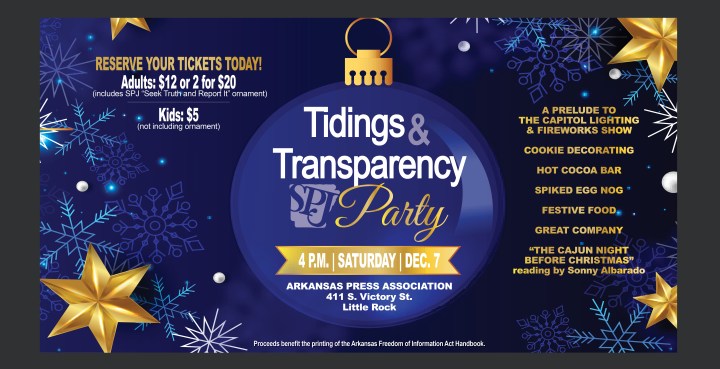
Kick off the evening with us and get your exclusive SPJ “Seek Truth and Report It” glass ornament. Then stroll over to the Capitol steps for the 86th Capitol Lighting Ceremony & Fireworks Show — the perfect holiday finale!
Date & Time: Saturday, Dec. 7, 4–5:15 p.m. The Capitol Lighting Ceremony starts at 5:30 p.m.
Hot Cocoa Bar Spiked Eggnog Festive Food Great Company
Special Reading: “The Cajun Night Before Christmas” by Sonny Albarado
Tickets & Details:
$12 per ticket or two for $20 (includes SPJ ornament)
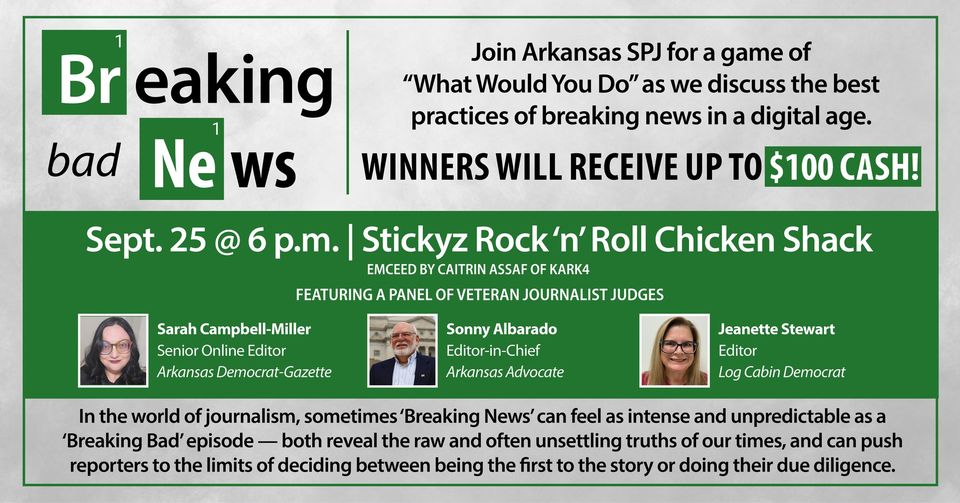
In the world of journalism, sometimes “Breaking News” can feel as intense and unpredictable as a “Breaking Bad” episode — both reveal the raw and often unsettling truths of our times, and can push reporters to the limits of deciding between being the first to the story or doing their due diligence. Join Arkansas SPJ at 6 p.m. Wednesday, Sept. 25, at Stickyz Rock ‘n’ Roll Chicken Shack in downtown Little Rock for a game of “What Would You Do” as we discuss the best practices of breaking news in a digital age. The event will be emceed by Caitrin Assaf of KARK 4 and judges are Arkansas Democrat-Gazette senior online editor, Arkansas Advocate Editor-in-Chief Sonny Albarado and Log Cabin Democrat Editor Jeanette Stewart. Winner(s) will take home up to $100 in cash!
Ahead of National Suicide Prevention Month in September, Arkansas SPJ presented the webinar From Stigma to Understanding: Best Practices for Suicide Reporting, a program highlighting the importance of responsible reporting on mental health and suicide, including safe reporting guidelines and resources for journalists.
Arkansas SPJ vice president and FOX16 evening anchor Kevin Kelly, who launched an anti-bullying campaign called Step-Up, Stop Bullying, moderated the program with Jacqueline Sharp, area director for the Arkansas chapter of the American Foundation for Suicide Prevention, and Aneri Pattani, a senior correspondent at KFF Health News, a national nonprofit outlet covering U.S. health care and health policy.
Additional resources:
Here is a link to the free online course Aneri Pattani helped create with Johns Hopkins University to teach journalists how to report on suicide responsibly.
Find the American Foundation for Suicide Prevention’s safe reporting guidelines for media here.
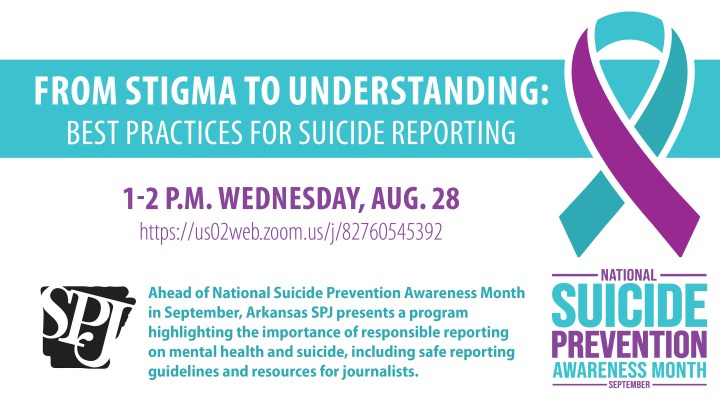
Ahead of National Suicide Prevention Awareness Month in September, Arkansas SPJ presents From Stigma to Understanding: Best Practices for Suicide Reporting, a program highlighting the importance of responsible reporting on mental health and suicide, including safe reporting guidelines and resources for journalists. The webinar will take place from 1-2 p.m. Wednesday, Aug. 28. Click the following link to join. https://us02web.zoom.us/j/82760545392
FOX16 evening anchor Kevin Kelly, who launched an anti-bullying campaign called Step-Up, Stop Bullying, will moderate the program with Jacqueline Sharp, area director for the Arkansas chapter of the American Foundation for Suicide Prevention, and Aneri Pattani, a senior correspondent at KFF Health News, a national nonprofit outlet covering U.S. health care and health policy.
Pattani’s reporting focuses on mental health, suicide, and substance use. She recently completed her masters in public health as a Bloomberg fellow at Johns Hopkins University, where she helped create a free online course to teach journalists how to responsibly report on suicide.
Sharp graduated from Arkansas Tech University in Russellville with a Bachelor of Science. While studying at university, Sharp said she volunteered for a mentoring program and fell in love with the nonprofit world. She has more than 12 years of nonprofit experience. She began her role with AFSP in August 2021. She said she was drawn to this work because of her own lived experience during postpartum; she has loved ones she supports who struggle, and she believes that mental health is physical health. She recently wrote a blog for Newsweek, helping to highlight her lived experience around maternal mental health.
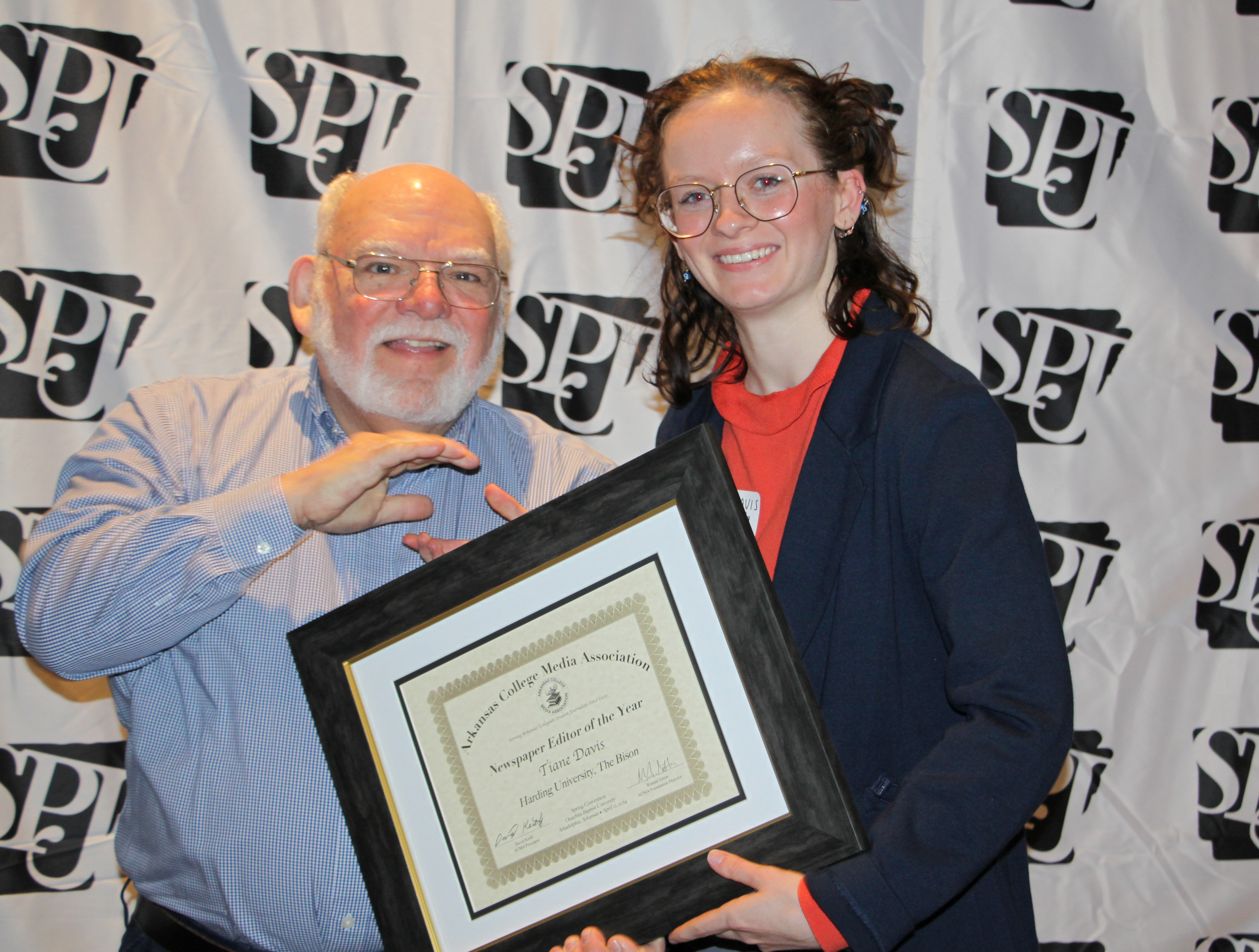
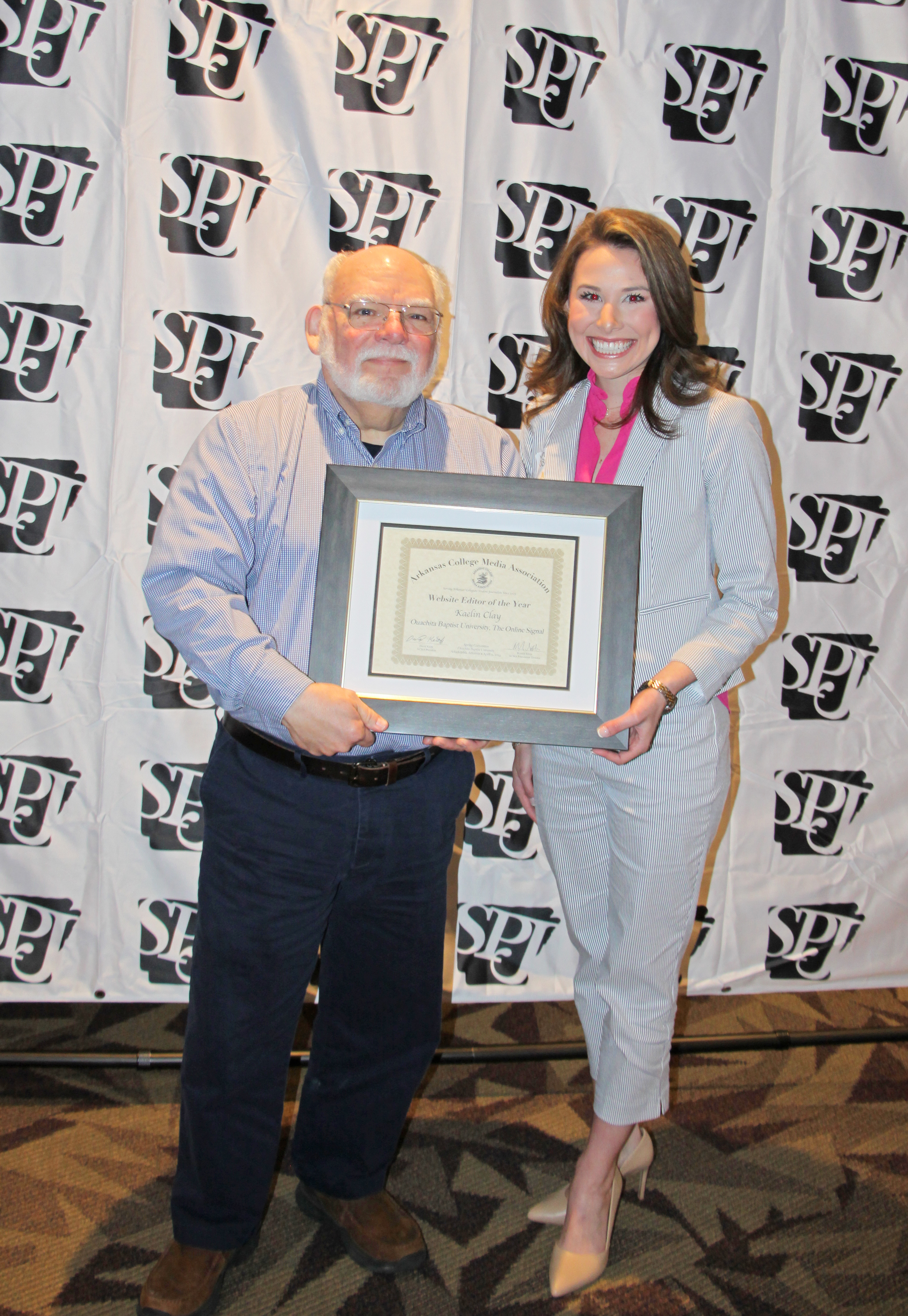
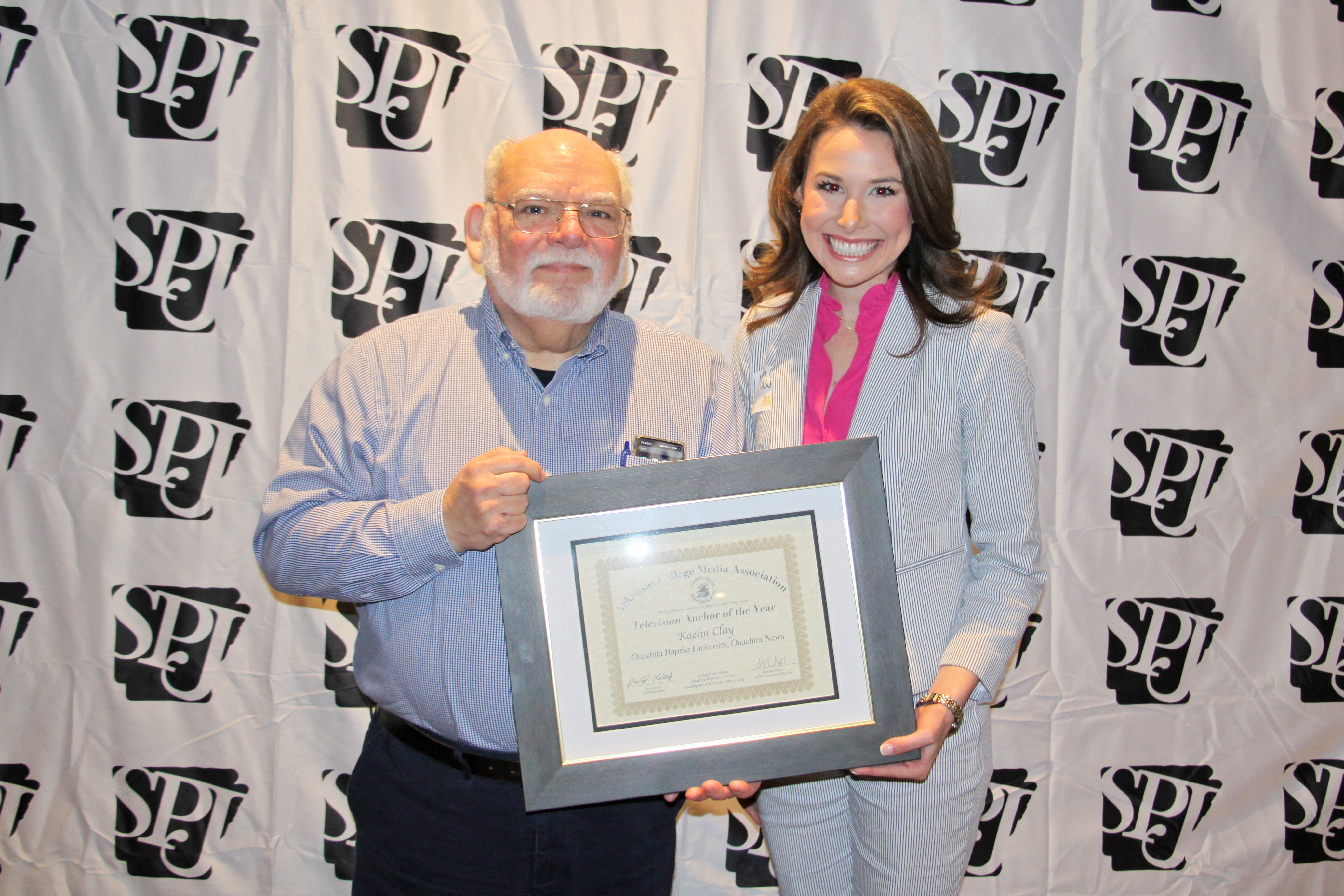
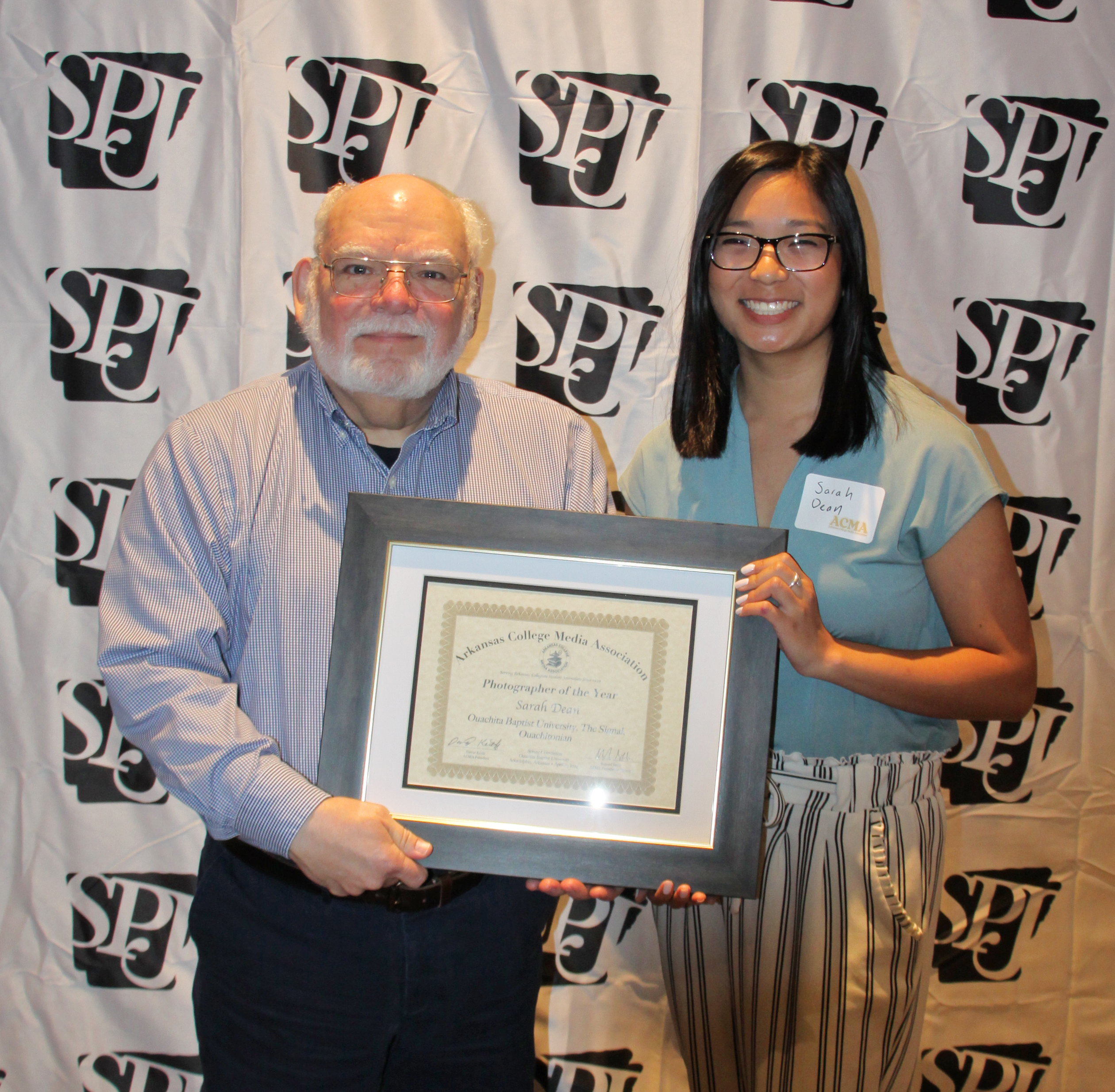
The Arkansas Pro Chapter of the Society of Professional Journalists awarded $3,250 in scholarships to six students at the Arkansas College Media Association convention, which was hosted on April 12 at Ouachita Baptist University in Arkadelphia.
Tiane Davis of Harding University was named Newspaper Editor of the Year and received a $1,000 scholarship. The judge said Davis was “a fantastic choice for the best of the best. The sheer volume of praise heaped upon her by people who know her best speaks to her importance to the staff, the publication and the campus. She is a wonderful example of how best to lead and manage a publication.”
Chase Hartsell of Ouachita Baptist University was named Reporter of the Year and received a $1,000 scholarship. The judge said it was a tough decision in a highly competitive category. “This reporter demonstrated the value of both the tangible skills associated with text-based and broadcast journalism as well as the intangibles, such as curiosity, wonder and general nosiness. The ability to take one’s gifts and sharpen one’s skills to create the ultimate storyteller is not often found, but here it exists in nearly perfect form. One instructor noted this individual was the best he’d seen in 32 years of education. I would be hard-pressed to disagree with that assessment.”
Easton John of Arkansas State University was named TV Producer/Director of the Year and was awarded a $250 scholarship. “It is clear that the continuing coverage and dedication to the craft of broadcasting is evident in this aspiring individual,” the judge said. “Easton John should be on the watch list for many, as his abilities span across multiple platforms with vigor and purpose. Keep up the good work, always challenge yourself, monitor the competition, and continue to hold yourself to high ethical and moral choices. Stay the course, lead by example, and safe journeys on your bright media future ahead.”
Kaelin Clay of Ouachita Baptist University won $250 awards for both Website Editor of the Year and Television Anchor of the Year. “All in all, it is clear that this person provides the heart and soul of this site and this site is worthy of great praise,” the judge said.
Sarah Dean, named Photographer of the Year, and Caroline Johnson Tubbs, named Designer of the Year, both of Ouachita Baptist University, were additional recipients of $250 scholarships. This year, no winner was awarded in the Yearbook Editor of the Year category.
Sarah Dean, named Photographer of the Year, and Caroline Johnson Tubbs, named Designer of the Year, both of Ouachita Baptist University, were additional recipients of $250 scholarships. This year, no winner was awarded in the Yearbook Editor of the Year category.
Little Rock, Ark. –Imagine you’re sitting at your desk or workstation in your newsroom.
You’re writing a story on deadline, concentrating on the monitor in front of you, when you hear a commotion out in the hallway.
At first you aren’t sure what the loud voices are saying. You try and tune out the boisterous conversation, and start to re-read your last sentence when suddenly a sharp crack – BANG – sounds in the hallway.
There’s a wail, then the succession gunshots and screams begin.
What do you do?
Do you have an escape route? Has your company ever discussed what to do in an active shooter situation? Have you ever seriously considered such a scenario while sitting in your office? Or how about while sitting at a school board meeting, or a city council gathering, or while covering a crime scene investigation?
Chances are you answered no to some, and maybe even all, of the above questions.
Workplace violence can occur in any employment setting, including newsrooms, whether they be at newspapers or television stations.
According to the 2019 report Indicators of Workplace Violence, compiled by the Bureau of Justice Statistics, the Bureau of Labor Statistics and the National Institute for Occupational Safety and Health and released in 2022, nearly 18,000 persons were killed at work, on duty, or in violence that was work-related over a 27-year period from 1992 to 2019.
According to the study, an annual average of 1.3 million nonfatal workplace violent victimizations occurred during the combined 5 years from 2015 to 2019, based on data from BJS’s National Crime Victimization Survey.
In June of 2018 a local resident, unhappy about having his police charges published in the Capital Gazette, a newspaper serving Annapolis, Md., brought a shotgun into the newsroom and killed five people.
The gunman, Jarrod Ramos, was doubly annoyed that his defamation lawsuit against the newspaper was dismissed in court. The paper had published an article in 2011 about Ramos being put on probation for harassing an acquaintance from high school via social media and email.
Allegedly Ramos sent angry letters and threats to the newspaper after the lawsuit was dismissed, but no legal action was taken by the newspaper after the threats were received.
So, on the afternoon of June 28, Ramos showed up with a 12-gauge Mossberg to register his complaint in blood. Five people, including Rob Hiaasen, brother of noted novelist Carl Hiaasen.
In 2021, Ramos was found guilty and sentenced to five life terms plus 345 years in prison.
But since 2018, three other American journalists have been murdered in separate incidents – Aviva Okeson-Haberman in Kansas City, Mo., Jeff German in Las Vegas and Dylan Lyons in Pine Hills, Fla.
Time Magazine reported in 2019 that statistically, the average American has a greater risk of dying from heart disease or cancer than from a firearm, according to the National Safety Council.
Auto accidents also kill about the same number of people in the U.S. as guns do each year, according to CDC statistics.
However, people in the U.S. are 25 times more likely to die from gun homicide than people in other wealthy countries, according to a 2016 study in the American Journal of Medicine.
Journalists are in a unique position. Not only are they subject to the random everyday workplace violence spawned by divorces, jealousy, terminations, robberies and disgruntled customers. Journalists also as part of their job often cover and expose facts about people that the subjects would prefer not to have exposed. Journalists go to the scenes of shootings, accidents, robberies, fires, floods and earthquakes. Besides the environmental dangers that can be posed in covering the news, there is also always the human factor which can result in tragedy.
Florida TV reporter Dylan Lyons was killed on the job while covering the murder of a woman in Pine Hills, a community just outside of Orlando. He was there filming when the suspect returned to the scene and shot Lyons and his cameraman Jesse Walden. Walden survived.
The five victims of the Annapolis mass shooting were in their work space, where it was literally just another day at the office – until it wasn’t.
After the shooting in Maryland, I decided to put together a presentation for the Arkansas Press Association on self-defense for journalists, which I finally got completed just in time for the COVID-19 pandemic to shut everything down.
Besides being a career journalist (I’m currently the editor of The Saline Courier in Benton, Ark.) with nearly 30 years’ experience, I also had a decade of Human Resources experience during which I encountered numerous violent workplace situations that could have escalated but, thankfully, did not result in any deaths.
I also am a martial artist, with four decades of study in a wide range of disciplines, and have taught women’s self-defense classes and assisted in teaching law enforcement self-defense classes over the years, so I thought I could offer some insights to my co-workers on staying safe both in the newsroom and out on the streets.
“Usually, self-defense is considered survival against unprovoked attacks by human attackers.
In actuality, self-defense is so much more nuanced than that. Preserving one’s life is far more complex than a few hand strikes or gunshots,” writes podcaster Serge Antonin on the website blackandwhiteandthinbluelines.com.
The essence of self-defense is awareness. Being aware of your surroundings both inside your newsroom and out on the street covering a story is the first, and biggest, step you can take toward being safe.
Antonin lists four essential types of awareness:
Situational Awareness — People often create circumstances that adversely affect them. Understanding this and the hazards created by strangers is paramount when considering self-defense.
Environmental Awareness — Understanding that different environments hold different perils is crucial.
Preparational Awareness — Possession of the proper tools, training, and mindset to survive an environment or live adversary is very important.
Capability Awareness — The accurate estimation of one’s abilities is critical.
Just as your company probably requires you to wear a reflective vest when covering traffic accidents, you should think of your awareness as your internal reflective vest and you should put it on whenever you go out to cover a story, especially one that involves violent crime.
Situational awareness requires you to see what is happening around you. It also requires that you listen to your gut instincts – If your little voice is telling you something is wrong, it probably is. Is that loud argument two tables over just rowdy friends or is it about to erupt in gunfire? Is the person who just walked into your office with his flow chart explaining how the President is trying to read his thoughts harmless?
Environmental awareness seems common sensical if you’re covering an ice storm or a wild fire, but it also applies to your workplace and home. Right now, look at your surroundings. If you spotted a shooter walking toward you, what would you do? Where would you go? Do you have an escape route? A second doorway or a window?
Preparational awareness is where we generally fall down as a profession, and as a society. Often, the thinking is the police will be there to handle any serious incidents, but sadly in most cases the police arrive after the shooting has begun, not before. Basic self-defense teachings aren’t part of most workplaces unless you are working in law enforcement or security, but a basic common-sense self-defense course, whether through the NRA or a concealed-carry instructor or a realistic self-defense program, such as Krav Maga, are really helpful. Often, police departments will offer basic courses to the public, and it would not be a bad idea to have one such course offered annually in newsrooms.
Capability awareness is best summed up by Dirty Harry Callahan’s edict delivered in the 1973 film Magnum Force: “A man’s got to know his limitations.”
The basic motto for active shooter situations is Run, Hide, Fight – and you should be able to do a little of all three. As horrible as active shooter drills in elementary schools sound, they are teaching skills that most adults who don’t have a military service background haven’t cultivated. Wherever you are, basic self-defense awareness includes finding the quickest way to the closest exit, looking for a safe barrier to duck behind, and having a basic idea of how to fend off an attacker.
Ultimately, defensive awareness should extend to all parts of one’s life. Living defensively doesn’t mean being paranoid or fearful. Tornadoes happen, and if you live in Arkansas, chances are you have a tornado close encounter story to tell. But you probably don’t run to the nearest closet every time it rains.
In the same fashion, being aware of the potential for violence and learning to pay attention to one’s surroundings can save lives – not only yours, but also those around you.
Randal Seyler is an Arkansas native and a career journalist, serving as editor for 17 different newspapers in four states since taking his first editor’s job in 1986. Currently he is managing editor of The Saline Courier in Benton, Ark. He has also studied a variety of martial arts over the past 45 years, and has taught karate and Tai Chi for over 30 years to hundreds of students. He is the author of Heads Up! Self Defense for Journalists. He is available for self-defense seminars and workplace violence prevention training. For more information, contact Randal at ransey303@gmail.com.
Welcome to the revamped 2024 Diamond Journalism Awards. We’ve added several new categories this year and reorganized categories by overall divisions for easier navigation. For entry rules go here.
The divisions:
DIVISION 1 – PRINT/ONLINE recognizes reporting and storytelling via the written word.
DIVISION 2 – TELEVISION recognizes visual reporting and storytelling via televised media.
DIVISION 3 – RADIO/AUDIO recognizes spoken-word reporting and storytelling via radio or podcast.
DIVISION 4 – SPECIAL TOPICS recognizes reporting and storytelling on certain topics from entrants regardless of medium.
DIVISION 5 – VISUAL JOURNALISM recognizes photography, graphics and design regardless of medium.
DIVISION 6 – COMMUNICATIONS recognizes reporting and storytelling by a public relations, communications or marketing professional or group regardless of medium or business affiliation.
DIVISION 7 – STUDENT JOURNALISM recognizes reporting and storytelling by student journalists regardless of medium.
DIVISION 8 – CRAFT ACHIEVEMENT recognizes excellence in the craft of news presentation.
DIVISION 9 – DIAMOND AWARDS recognizes outstanding work regardless of the medium for community journalism, public service reporting, freedom of information reporting, best new journalist, best student journalist and journalist of the year.
DIVISION 1: PRINT/ONLINE
(Entries accepted from print and online-only publications)
BREAKING NEWS – For clear, accurate and engaging coverage of a single, unexpected news event by an individual or team. Judges will consider deadline pressure and the complexity of the subject. Submit up to three articles from same-day coverage, including sidebars or related multimedia content.
GENERAL NEWS – For non-breaking news coverage. It may include planned coverage of a single event or in-depth reporting. Submit up to three articles and any related multimedia content.
CONTINUING COVERAGE – For ongoing coverage of a topic or significant event over time, demonstrating solid reporting and presentation with complexity and perspective. Submit up to five stories along with any related multimedia content. Entries may include a mix of story types.
ENTERPRISE/IN-DEPTH REPORTING – For coverage that reflects initiative, ingenuity, use of sources and/or special research to dig deeper or capture more complexity than a typical news story. Submit a single story or a series of up to three stories and any related multimedia content. Entry can be by an individual or team.
INVESTIGATIVE REPORTING – For reporting that demonstrates initiative, persistence and resourcefulness in pursuing information that is restricted, hidden by officials or not readily available and is of public interest and significance. COVER LETTER REQUIRED, explaining reporting process and impact or results. Submit one story or a series of no more than six stories and any related multimedia content.
EXPLANATORY REPORTING – For reporting and writing that makes clear significant stories and complex situations that deepen understanding of a subject or focus on subjects covered minimally or not at all by most media. Submit one story or a series of no more than six stories and any related multimedia content.
EDITORIALS – For opinion writing representing a news organization’s position on a topic or issue. Judges will consider the value to the community, writing style, reasoning, originality and reader interest. Submit three editorials as one entry.
COMMENTARY – For commentary or analysis by an individual. News-oriented blogs are also eligible. Judges will consider the quality of expression, clarity and originality. Submit three columns as one entry.
FEATURES – For individual storytelling excellence. Judges will consider the use of narrative, humor or drama, style, creativity, clarity and suitability of the writing to the subject. Submit one story.
PROFILES – For reporting that depicts the character and personality of a story subject. Submit one story.
SPORTS – For coverage of any sport or athletic endeavor. Judges will consider clarity and style. Submit a single story or no more than three stories representing continuing coverage of a single topic.
SPORTS FEATURE – For outstanding storytelling about athletic participants or a sport itself. Submit a single story.
ARTS & ENTERTAINMENT COVERAGE – For coverage of the arts, entertainment or other cultural news. Entry may include news, profiles and features. Judges will consider the quality of the writing and presentation and, where appropriate, analysis. Submit up to three stories on a single topic or various topics.
CRITICISM/REVIEWS – For writing demonstrating a journalist’s competence in evaluating performance, restaurants, books, recorded music or other cultural events or entities. Submit three pieces by one author as one entry.
EDUCATION – For coverage of schools, teaching or education-related topics by an individual, team or staff. Submit up to five samples and any related multimedia content as one entry.
POLITICS – For coverage of public issues, elections, political campaigns, candidates, campaign finance or government by an individual, team or staff. Submit up to five stories and related multimedia content as one entry.
SPECIAL SECTION/NICHE PUBLICATION – For a niche publication or special section devoted to a single topic. Judges will consider the depth of coverage, presentation, and quality of writing. Submit one section or niche publication.
DIVISION 2: TELEVISION
(Entries accepted from broadcast and cable TV outlets or other video outlets)
GENERAL NEWS GATHERING ENTRY REQUIREMENTS:
The original video and submission length may be at most 10 minutes for single news entries. Eligible multipart news series entries may include two (2) but at most five (5) separate reports from the series. The total submission time limit for news series entries may be at most 15 minutes.
BREAKING NEWS – For coverage of a single unexpected news event that highlights urgency. Submit a video from same-day coverage. Submission length must not exceed 10 minutes.
CONTINUING COVERAGE – For ongoing coverage of a topic or significant event over time. Entry should not be longer than 15 minutes.
EXPLANATORY REPORTING – For coverage of a complex issue that clearly explains a topic or event from start to finish. Entry should not be longer than 15 minutes.
INVESTIGATIVE – For a single report or series that focuses on one subject matter and includes extensive research. Entry should not be longer than 15 minutes.
NEWS FEATURE – For a single story that includes a personal, emotional or creative slant beyond just gathering facts. Entry should not be longer than 15 minutes.
ARTS & ENTERTAINMENT – For general entertainment and/or performing arts coverage. Entry should not be longer than 15 minutes.
CRIME/JUSTICE – For coverage of crime, victims or justice-related topics. Entry should not be longer than 15 minutes.
PROFILES – For coverage of an individual who has overcome obstacles or made significant contributions to their community. Entry should not be longer than 15 minutes.
EDUCATION – For coverage of schools, teaching or education-related topics. Entry should not be longer than 15 minutes.
POLITICS – For coverage of political, civil or government-related topics. Entry should not be longer than 15 minutes.
WEATHER – For coverage of a weather-related event. Entry should not be longer than 15 minutes.
SPORTS STORY– For coverage of a single sporting event, athletes, coaches and other related topics. Entry should not be longer than 15 minutes.
SPORTS PROGRAM – For a daily or weekly sports program, which can be live or pre-recorded. Maximum run time: 30 minutes.
NEWSCAST – For excellence in a regularly scheduled newscast. Judges will consider overall content, presentation, enterprise, writing, format, teases, etc. NOTE: This award is for producers only. Please remove all commercial breaks with 2 seconds of black between each break. For newscasts exceeding 30 minutes, entrants may submit up to 3 excerpts.
DIVISION 3: RADIO/AUDIO
(Entries accepted from broadcast radio, podcasts and other outlets producing audio)
BREAKING NEWS – For clear, accurate and engaging coverage of a single unexpected news event by an individual or team. Judges will consider deadline pressure and the complexity of the subject. Submit audio from same-day coverage. Submission length must not exceed 15 minutes.
GENERAL NEWS – For non-breaking news coverage. It may include planned coverage of a single event or in-depth reporting. Submit audio from a single story. Submission length must not exceed 15 minutes.
CONTINUING COVERAGE – For ongoing coverage of a topic or significant event over time, including several reports over some time. Entry should not be longer than 15 minutes.
ENTERPRISE/EXPLANATORY REPORTING – For coverage that reflects initiative, ingenuity, use of sources and/or special research to dig deeper or capture more complexity than a typical news story. Submit audio from a single report or a series of reports not longer than 30 minutes in total. Entry can be by an individual or team.
INVESTIGATIVE REPORTING – For reporting that demonstrates initiative, persistence and resourcefulness in pursuing information that is restricted, hidden or not readily available and is of public interest and significance. COVER LETTER REQUIRED, explaining reporting process and impact or results. Submit a single piece or a series on the same topic with a maximum combined run time of 60 minutes.
FEATURES – For individual storytelling excellence. Judges will consider the use of narrative, humor or drama, style and creativity beyond just gathering facts. Submit one story of not more than 15 minutes.
PROFILES – For reporting that depicts the character and personality of a story subject. Submit one story of no more than 15 minutes.
SPORTS – For coverage of any sport or athletic endeavor, including features about athletes or a specific sport. Judges will consider clarity and style. Submit audio of no more than three reports covering a single topic with a run time of 15 minutes or less.
ARTS & ENTERTAINMENT – For coverage of the arts, entertainment or other cultural news. Entry may include news, profiles and features. Judges will consider the quality of the writing and presentation and, where appropriate, analysis. Submit up to three stories on a single topic or various issues with a total run time of not longer than 15 minutes.
EDUCATION – For coverage of schools, teaching or education-related topics by an individual or team. Submit up to five audio pieces with a run time of not more than 15 minutes.
POLITICS – For coverage of public issues, elections, political campaigns, candidates, campaign finance or government by an individual or team. Submit up to five audio pieces with a total run time of not more than 15 minutes.
DIVISION 4: SPECIAL TOPICS – ALL MEDIA
(Entries accepted from any medium)
HEALTH – For reporting clearly on health, including medicine, community health and health policy, and the health effects of COVID-19 by an individual or team. Print/online: Submit three to five stories and related multimedia content as one entry. TV/Radio/Audio: An entry should not exceed 15 minutes.
ENVIRONMENT/SCIENCE – For reporting by an individual or team on environmental issues, including climate change; or science, including technology, and the impacts on individuals and society. Print/online: Submit three to five stories and related multimedia content as one entry. TV/Radio/Audio: An entry should not exceed 15 minutes.
RELIGION – For reporting by an individual or team on religion, issues of faith or spirituality. Print/online: Submit three to five stories and related multimedia content as one entry. TV/Radio/Audio: An entry should not exceed 15 minutes.
BUSINESS – For coverage of business, finance or consumer issues by an individual, team or staff. Print/online: Submit three to five stories and any related multimedia content. TV/Radio/Audio: Submit up to five audio pieces with a maximum run time of 15 minutes.
DIVISION 5: VISUAL JOURNALISM & DESIGN
(Entries accepted from any medium)
BREAKING NEWS PHOTOGRAPHY – For photojournalism produced on deadline. Judges will consider deadline pressure, the complexity of the subject and visual presentation. Submit photos with cutlines from up to three stories as one entry, but no more than six images. Be sure to include the accompanying story or link to the story.
GENERAL NEWS PHOTOGRAPHY – For photojournalism by an individual for any non-deadline news event. Submit a single photo with a cutline/caption. Link to or include accompanying story – if any.
FEATURE PHOTOGRAPHY – For feature photography by an individual. Submit a single photo with a cutline/caption. Link to or include the accompanying story, if any, or contextual information.
PHOTO SPREAD/ESSAY – For a group of photographs on a single theme published as part of a single story or as a stand-alone layout. Submit no more than six images with cutlines. Link to or include the accompanying story or contextual information.
GRAPHICS/ILLUSTRATIONS – For infographics, illustrations or data visualizations. Submit up to three examples by an individual or team as one entry, including the associated stories or links to them online.
FRONT PAGE DESIGN-NEWSPAPERS – For layout that enhances and improves audience experience and engagement. Submit PDFs or links of up to three pages as one entry.
COVER DESIGN-MAGAZINES – For layout that enhances and improves audience experience and engagement. Submit PDFs or links of up to three pages as one entry.
WEB DESIGN – For presentation that enhances and improves audience experience and engagement. Submit PDFs or links of up to three pages as one entry.
DIVISION 6: COMMUNICATIONS
(Entries accepted from marketing and PR firms and corporate communications teams)
PRESS RELEASE WRITING – For excellence in press release writing by an individual published or distributed by a business or organization. Submit a PDF or link to a single press release.
FEATURE WRITING – For excellence in feature writing by an individual published or distributed by a business or organization. Submit a PDF or link to a single feature story.
PHOTOGRAPHY – For excellence in photography by an individual published or distributed by a business or organization. Submit a jpeg, png, PDF or link to a single photo.
CAMPAIGN – For excellence in the creation and execution of any advertising, marketing or promotional campaign by an individual or group that was published or distributed to promote a business or organization’s specific objectives. This includes social media, digital, print, multimedia, advertising, internal promotion, direct mailing, printed booklets, etc. or any combination of these items. Submit PDFs or links to at least three pieces of the campaign and a description of the campaign’s goals, execution details and any available results.
NEWSLETTER – For excellence in newsletters for corporations, nonprofits or other organizations. Submit up to three newsletters via links or PDFs with confirmation of send.
PROMOTIONAL PUBLICATIONS – For excellence in publications intended for an audience other than an internal audience. Submit one complete publication via PDF or link.
DIVISION 7: STUDENT JOURNALISM – ALL MEDIA
STUDENT-SPECIAL PROJECTS – For special projects that show exemplary reporting, writing, photography or videography. These should be student-generated and not part of an ongoing university-sponsored project. COVER LETTER REQUIRED.
STUDENT-BREAKING NEWS – For clear, accurate and engaging coverage of a single, unexpected news event by individuals or teams. Judges will consider deadline pressure and the complexity of the subject. Submit up to three articles, audio or video from same-day coverage, including sidebars or related multimedia content.Audio and video clips should not exceed 15 minutes.
STUDENT-GENERAL NEWS – For non-breaking news coverage. It may include planned coverage of a single event or in-depth reporting. Submit up to three articles, audio or video, including sidebars or related multimedia content. Audio and video clips should not exceed 15 minutes.
STUDENT-FEATURES – For individual storytelling excellence. Judges will consider the use of narrative, humor or drama, style, creativity, clarity and suitability of the content to the subject. Submit one story. Audio and video entries should not exceed 15 minutes.
STUDENT-SPORTS – For coverage of any sport or athletic endeavor regardless of platform. Judges will consider clarity and style. Submit a single story or no more than three stories representing continuing coverage of a single topic. Audio and video clips should not exceed 15 minutes.
STUDENT-EDITORIALS – For opinion writing representing a news outlet’s position on a topic or issue. Judges will consider the value to the community, style, reasoning, originality, and audience interest. Submit three editorials as one entry. Audio and video entries should not exceed 15 minutes.
STUDENT-COMMENTARY – For commentary or analysis by an individual. Blogs are eligible. Judges will consider the quality of expression, clarity, and originality. Submit three pieces as one entry. Maximum run time for video or audio: 15 minutes.
STUDENT-ARTS & ENTERTAINMENT REPORTING – For coverage of arts, entertainment, restaurants and other cultural news. Entry may include columns, profiles or features. Judges will consider the quality of the content and presentation and, where appropriate, analysis. Submit three samples as one entry. Maximum run time for video or audio: 15 minutes.
STUDENT-CRITICISM/REVIEWS – For analysis demonstrating a journalist’s competence in evaluating performances, restaurants, books, recorded music, motion pictures or other cultural events or entities. Submit three samples as one entry. Maximum run time for video or audio: 15 minutes.
STUDENT-BUSINESS – For coverage of consumer issues, business or finance, including the college athletics industry and the finances of institutions of higher learning. Judges will consider clarity and readability. Submit a single story or no more than three stories representing continuing coverage of a single topic. Maximum run time for video or audio: 15 minutes.
STUDENT-EDUCATION – For coverage of education and academic policy, including institutions of higher education, teacher training and educational research. Judges will consider clarity and thoroughness. Submit three stories as one entry. Maximum run time for video or audio: 15 minutes.
STUDENT-NEWS PHOTO – For photojournalism by an individual of breaking or general news. Judges will consider visual presentation and photographic techniques. Submit one photo with an accompanying cutline/caption or video clip of not more than five minutes. Please include the accompanying story or link the story.
STUDENT-FEATURE PHOTO – For feature photography by an individual. Judges will consider the complexity of the subject and visual presentation. Submit one photo with an accompanying cutline/caption. Please include the accompanying story or link the story, if any.
STUDENT-PHOTO SPREAD/ESSAY – For a group of photographs on a single theme published as part of a single story or as a stand-alone layout. Submit the page or up to six images with cutlines/captions and an explanation of the context or the accompanying story or text. Links are acceptable.
STUDENT-PHOTO PORTFOLIO – For photography that shows the work of a single photographer. Submit three to five photos with cutlines/captions.
STUDENT-GRAPHICS/ILLUSTRATIONS — For infographics, illustrations or data visualizations. Submit three to five examples by an individual or team as one entry, including the associated stories or links to them online.
STUDENT-PAGE DESIGN – For presentation that improves audience experience and engagement in print or online. Submit three examples as one entry.
DIVISION 8 – CRAFT ACHIEVEMENT
(Recognizes excellence by an individual engaged in the craft of news presentation)
OUTSTANDING NEWS ANCHOR – Based on coverage of several topics, credibility, delivery, and overall talent. Entry can include segments from regular newscasts, news specials, breaking news, etc. Entry should be no longer than 15 minutes, with two seconds of black between each segment.
OUTSTANDING METEOROLOGIST – For regular weather segments or coverage of weather events. Entry should be no longer than 15 minutes, with two seconds of black between each segment.
OUTSTANDING SPORTS ANCHOR – For regular sports segments or coverage of special sports events. Entry should be no longer than 15 minutes, with two seconds of black between each segment.
OUTSTANDING TV NEWS WRITER – For excellence in news writing by an individual. Submit three to five excerpts as one entry. Maximum run time is 15 minutes, including two seconds of black between segments. Please include scripts.
OUTSTANDING TV EDITOR – For excellence in video editing by an individual. Submit three to five excerpts as one entry. Maximum run time is 15 minutes, including two seconds of black between segments.
OUTSTANDING PRINT/ONLINE EDITOR – For excellence in editing by line or copy editors. Submit three to five examples of how editing improved a reporter’s work. If possible, include original work or proof of edits for comparison.
OUTSTANDING TV PHOTOGRAPHER – For excellence in TV photography by an individual. Submit up to five excerpts as one entry. Maximum run time is 15 minutes, including two seconds of black between segments.
OUTSTANDING STILL PHOTOGRAPHER – For photography that shows the work of a single photographer. Submit or link three to five photos with cutlines/captions as one entry.
OUTSTANDING RADIO/PODCAST HOST – For excellence in program or podcast hosting. Submit no more than five excerpts showing the host’s work with two-second breaks between excerpts.
DIVISION 9 – DIAMOND HONORS – ALL MEDIA
(Entries accepted from all media)
CHARLOTTE TILLAR SCHEXNAYDER PUBLIC SERVICE AWARD – For journalism that seeks to benefit society through extensive coverage of an issue facing a community, state or region. Awarded in honor of the late Charlotte Schexnayder, journalist, small-town newspaper publisher and Arkansas legislator. Entry MUST INCLUDE A COVER LETTER providing background context and results, if any. Judges will consider the issue’s significance, journalistic initiative, presentation, and results, if any. Submit five to seven articles — stories and opinion pieces. Maximum total run time for audio and video entries: 30 minutes.
ROBERT S. MCCORD FOI AWARD – For coverage that focuses on the public’s right to know and carries on the legacy of the late Robert McCord, a former national SPJ president who is considered the father of the Arkansas Freedom of Information Act. COVER LETTER REQUIRED. Submit stories, opinion pieces, letters or other material (including audio or video) demonstrating how the nominee contributed to protecting or enhancing the public’s right to know. Limit of 10 articles or audio/video pieces. Audio or video limited to 30 minutes total.
STUDENT JOURNALIST OF THE YEAR – For journalistic excellence demonstrated by an individual enrolled in an institution of higher learning. COVER LETTER REQUIRED.Submit a portfolio of five to seven pieces representative of work over the calendar year. Audio or video limited to 30 minutes total.
EMERGING JOURNALIST OF THE YEAR – For journalistic excellence demonstrated by an individual who has worked fewer than five years in journalism. COVER LETTER REQUIRED.Submit a portfolio of five to seven pieces representative of work over the year. Audio or video limited to 30 minutes total.
DIAMOND JOURNALIST OF THE YEAR – For reporting excellence by a journalist in any medium over the preceding year. COVER LETTER REQUIRED. Submit a portfolio of five to seven pieces representative of work over the year. Audio or video limited to 30 minutes total.
On Saturday, Sept. 9, Arkansas Pro SPJ, NWA Arkansas Pro SPJ, Arkansas Press Women and Arkansas College Media Association sent a letter to legislative leaders urging them to reject a move by Gov. Sarah Huckabee Sanders and her legislative enablers to gut the Arkansas Freedom of Information Act.
The General Assembly convenes Monday morning for a special session and is expected to complete its business by Wednesday. It’s urgent that supporters of the FOIA contact lawmakers and tell them keep their hands off the people’s law.
A couple of ways to do that: Go to the list of legislators and email them or click on your legislator’s name and call him or her. Or sign this petition being circulated by For AR People.
A copy of the letter we sent on Saturday is below.
Arkansas Pro Chapter Society of Professional Journalists September 9, 2023
House Speaker Matthew Shepherd House Republican Leader Marcus Richmond House Democratic Leader Tippi McCullough Senate President Pro Tempore Bart Hester Senate Republican Leader Blake Johnson Senate Democratic Leader Greg Leding CC: Rep. David Ray, HB 1003 sponsor Sen. Scott Flippo, SB 7 sponsor
Honorable leaders of the Arkansas General Assembly:
As citizens of Arkansas and affiliate members of state and national journalism groups, we must express our gravest concerns over House Bill 1003 and Senate Bill 7 that you will be considering in next week’s special legislative session. The Arkansas Freedom of Information Act has stood as a bulwark against overreaching and secrecy-driven officials for 56 years. Despite numerous amendments we believe have weakened it over time, it remains one of the strongest guarantees of government openness and transparency in the nation. Now, you are being asked by some of your colleagues and the governor to create several new exemptions to the law that will shatter citizens’ protection and violate the law’s presumption in favor of disclosure and transparency. If passed and enacted into law as written, the bill will lock critical elements of state government in a black box, away from the people who have a right to know what the government does in their name and how it spends their money. Arkansas’ Freedom of Information Act was passed under Gov. Winthrop Rockefeller, who broke Democrats’ grip on the statehouse by running as a reformer — when just 11% of the state was Republican. Transparency in government was and still is a Republican mantra. In part, the FOIA’s promise to the public is what made Republican governance possible in Arkansas. Forgoing that pledge breaks a bond with your constituents and destroys that legacy. The proposed legislation also purports to be about protecting the security of the governor, the governor’s family and other state officials, but it goes well beyond security issues. There are legitimate concerns about revealing security planning and protocols, which we believe existing law addresses. Hiding information about executive branch travel and its costs from the public is a bridge too far. Similarly, creating a new exemption for the “deliberative process” would sweep up information vital to citizen self-governance. A working papers exemption already exists for the governor’s office, attorney general, legislators and Supreme Court and Appeals Court justices and judges. That should suffice. Preventing the public from knowing “how the sausage is made” and what executive branch agencies are doing violates the spirit and legal precedent of the FOIA. The overly broad exemptions created by this bill all but guarantee the demise of Arkansas as a beacon of transparency. Democracy dies in darkness, as the saying goes. In an era of declining trust in our institutions and officials, I hope you will agree with us that more, not less, transparency is a good thing and that it is a nonpartisan issue. We ask that you reject this overreach on the part of the governor’s office.
Sincerely, Sonny Albarado Vice President, Arkansas Pro Chapter of the Society of Professional Journalists and past national president of SPJ (2012-13)
Gina Holland Shelton President, NWA SPJ Pro Chapter
Kristin Netterstrom Higgins President, Arkansas Press Women
Jennifer Ellis Region 12 Coordinator, Society of Professional Journalists
David Keith President, Arkansas College Media Association
Ron Sitton Director, Arkansas College Media Association
Bret Schulte Freelancer, board member, NWA SPJ Pro Chapter
Other Co-signers: Arkansas SPJ Pro: President Brenda Lepenski, Secretary Wendy Miller Jordan, Treasurer Rob Moritz, Past President Steve Listopad, board members Karen Steward, Terrance Armstard, Jack Webb Arkansas Press Women: Treasurer Richard Plotkin, Secretary Debbie Miller, Northwest District Director Catherine Nolte and Central District Board member Tammy Keith University of Arkansas Student SPJ Chapter

 Newspaper Editor of the Year
 Reporter of the Year
 TV Anchor of the Year
 Photographer of the Year
 TV Producer/Director of the Year
 Designer of the Year
 Website Editor of the Year
 Yearbook Editor of the Year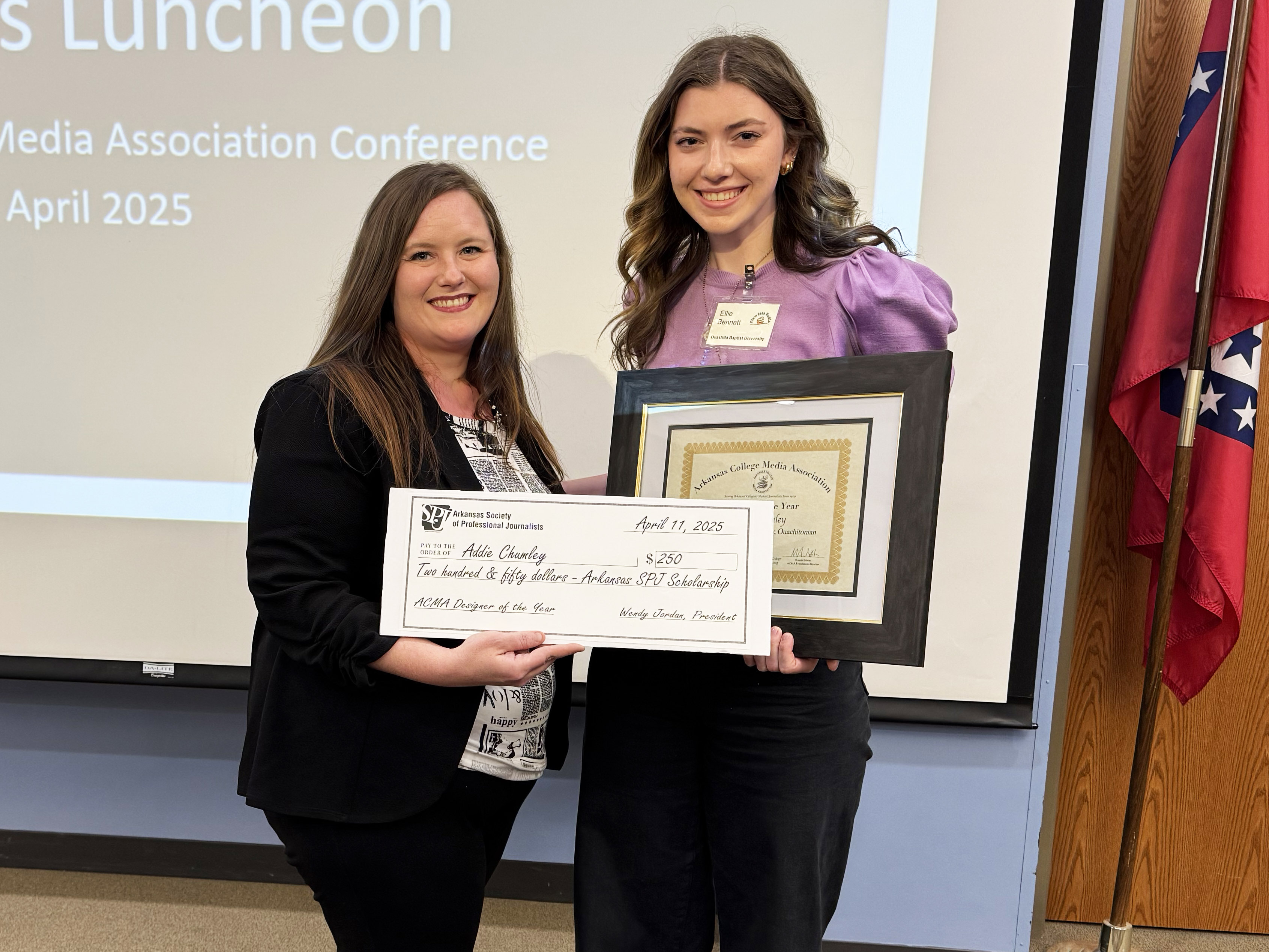
 Then stroll over to the Capitol steps for the 86th Capitol Lighting Ceremony & Fireworks Show
  — the perfect holiday finale!
 Date & Time:
 Hot Cocoa Bar
 Spiked Eggnog
 Festive Food
 Great Company
 Special Reading:
 Tickets & Details:
 Reserve your tickets today to secure parking!





 Society of Professional Journalists | Arkansas Pro Chapter